Lecture | Frédéric Ogée on Hogarth and the English Enlightenment
Presented by the Lewis Walpole Library:
Frédéric Ogée | Art and Truth: William Hogarth and the English Enlightenment
28th Lewis Walpole Library Lecture
Yale University Art Gallery, New Haven, 12 February 2026
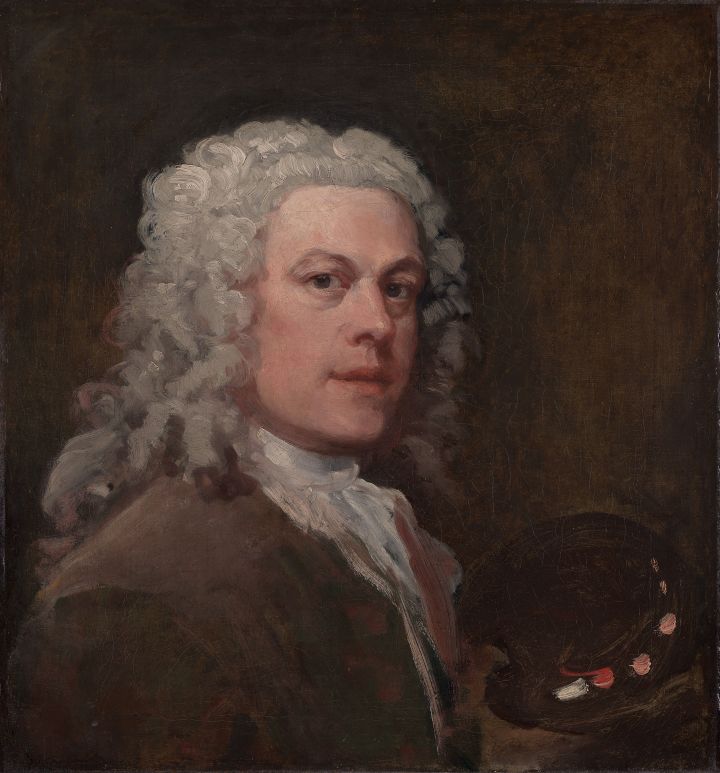
William Hogarth, Self-Portrait, ca. 1735, oil on canvas (New Haven: Yale Center for British Art, Paul Mellon Collection, B1981.25.360).
William Hogarth was a pioneering painter and engraver of 18th-century Britain and is often considered as one of the most important figures in the rise of an English school of art. His art engaged in an unprecedented manner with the ideas, debates, and values of the English Enlightenment, translating them into accessible visual narratives, encouraging the development of active critical thinking. As such his art reflected and nourished the English Enlightenment’s empiricist agenda—the idea that knowledge comes from observation and experience—to which he gave accessible visibility by bringing art into the realm of popular culture and public discourse, and putting the distinctions between ‘high’ and ‘low’ art under serious stress. His major contribution to the promotion of a ‘modern’ (and English) conception of art is the unflinching priority he always gave to truth over beauty in his representations, a feature, remarkably, that has remained characteristic of British art ever since.
Frédéric Ogée is Emeritus Professor of British Literature and Art History at Université Paris Cité and École du Louvre. His main period of research is the long eighteenth century, and his publications include two collections of essays on William Hogarth, as well as ‘Better in France?’ The Circulation of Ideas across the Channel in the Eighteenth Century (Lewisburg, 2005), Diderot and European Culture (Oxford, 2006; repr.2009), and J.M.W. Turner, Les paysages absolus (Paris, 2010). He also co-edited Jardins et civilisations (Valenciennes, 2019) following a conference at the European Institute for Gardens and Landscapes in Caen. In 2006–07, he curated the first-ever exhibition of Hogarth for the Louvre Museum. He is currently working on a series of four large monographs in French on eighteenth- and nineteenth-century British artists. The first one, Thomas Lawrence: Le génie du portrait anglais was published in December 2022. The second one, on the landscape artist J.M.W. Turner, will be published early in 2026.
Thursday, 12 February 2026, 5.30pm
Yale University Art Gallery Auditorium
Exhibition | Gardens of Enlightenment, 1750–1800
Opening in May at Versailles:
Gardens of Enlightenment, 1750–1800 / Jardins des Lumières, 1750–1800
Grand Trianon and English Garden of the Petit Trianon, Château de Versailles, 5 May — 27 September 2026
Curated by Elisabeth Maisonnier
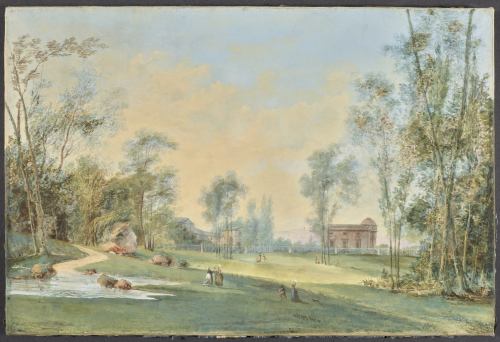
Louis Belanger, The Borders of the Bagatelle Pavilion, 1785, gouache on vellum (Château de Versailles, Dist. RMN).
In spring 2026, Gardens of Enlightenment (1750–1800) will open, bringing together nearly 150 works—paintings, drawings, furniture, architectural projects and costumes—to reveal the originality and diversity of landscaped gardens designed in the second half of the eighteenth century. Inspired by a model that emerged in Great Britain in the 1730s, this new style freed itself from the rules of the French formal garden, breaking with symmetry and geometric layouts in favour of irregularity, the picturesque, and a poetic evocation of nature. From the middle of the century onwards, this aesthetic spread across northern Europe in a wave of Anglomania that combined eccentric garden follies, philosophical reverie, a taste for exoticism and the search for an intimate refuge.
The exhibition explores its many sources—from Antiquity to China—as well as the new ways of life it accompanied, oscillating between rural pleasures, festivities, and contemplation. The exhibition route will engage in close dialogue with the historic gardens of the Trianon estate, offering a new perspective on the elements of its English garden: the Belvedere, the Temple of Love, and the Queen’s Hamlet.
Jardins des Lumières, 1750–1800 is curated by Elisabeth Maisonnier, Chief Curator of Heritage, Château de Versailles.
New Book | Portrait Miniatures
As noted by Adam Busiakiewicz, at Art History News; from Michael Imhof:
Bernd Pappe and Juliane Schmieglitz-Otten, eds., Portrait Miniatures: Artists, Functions, Manufacturing Aspects, and Collections (Petersberg: Michael Imhof Verlag, 2025), 288 pages, ISBN: 978-3731915096, €40.
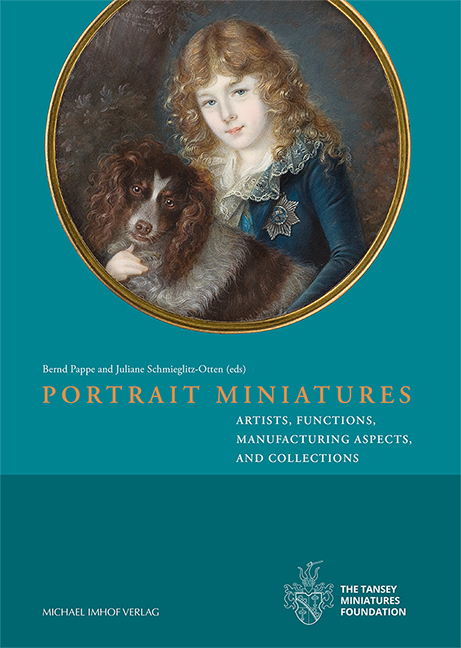 Twenty-two renowned experts from nine countries present the miniature portrait from different perspectives, discussing the private use of miniatures, special depictions, and messages conveyed by miniatures. Significant but little-known museum collections are introduced alongside insightful information about the living conditions of the artists active at the time. Lastly, aspects regarding the production techniques for miniatures are examined.
This fourth volume publishes the presentations given at the 2024 conference held by the Tansey Miniatures Foundation. Interested individuals from all over the world come together in Celle every two to three years at these conventions on the portrait miniature to discuss this special genre of portrait painting.
The table of contents can be seen here»
Exhibition | Hercules: Hero and Anti-Hero
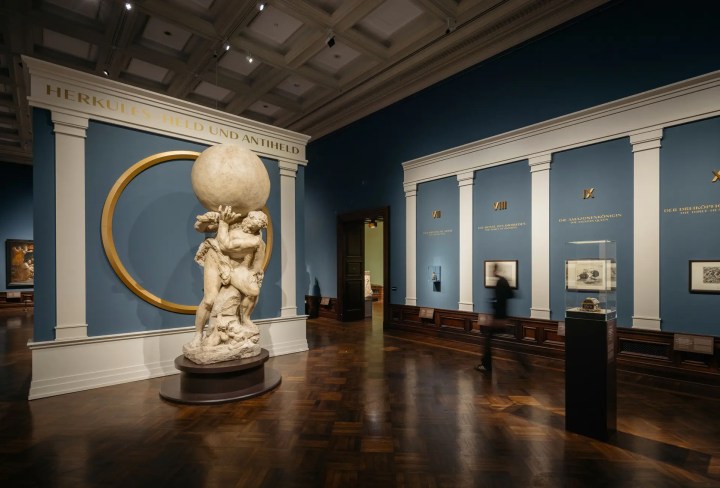
Exhibition photo with a mid-19th-century plaster cast after Balthasar Permoser’s ‘Saxon Hercules’. As noted on the SKD’s Instagram account, “The original crowned the Wall Pavilion of the Dresden Zwinger from 1718 to 1945, symbolising its patron, Augustus the Strong, with his astonishing physical strength and the Herculean efforts he undertook every day as the Saxon-Polish ruler. Where Hercules dwells with the vault of heaven, the Garden of the Hesperides cannot be far away. And so Permoser’s Hercules gazed upon the orange trees in the Zwinger courtyard, which bore the apples of the Hesperides, as it were, and promised Saxony a golden age.”
◊ ◊ ◊ ◊ ◊
From the press release for the exhibition:
Hercules: Hero and Anti-Hero
Gemäldegalerie Alte Meister, Zwinger, Dresden, 22 November 2025 — 28 June 2026
Hercules (‘Heracles’ in Greek), the best-known hero of classical antiquity, is one of the most enduring and popular mythical figures anywhere in the world. His name is universally known, and the phrase ‘a Herculean task’ is an everyday expression for anything requiring extraordinary strength and effort.
The Staatliche Kunstsammlungen Dresden (Dresden State Art Collections, SKD) is dedicating an exhibition to this demigod in the Winckelmann Forum of the Semper Gallery of the Zwinger. With Hercules: Hero and Anti-Hero, the Skulpturensammlung bis 1800 (Sculpture Collection up to 1800) and the Gemäldegalerie Alte Meister (Old Masters Picture Gallery) present a wide range of depictions of this mythological character. Featuring 135 objects, including top-quality sculptures, paintings, prints, coins, armour, and works of the goldsmith’s art, the exhibition explores the question of why Hercules has been such a fascinating figure for millennia and continues to be so today—one need only think, for example, of some of the major films of recent years.
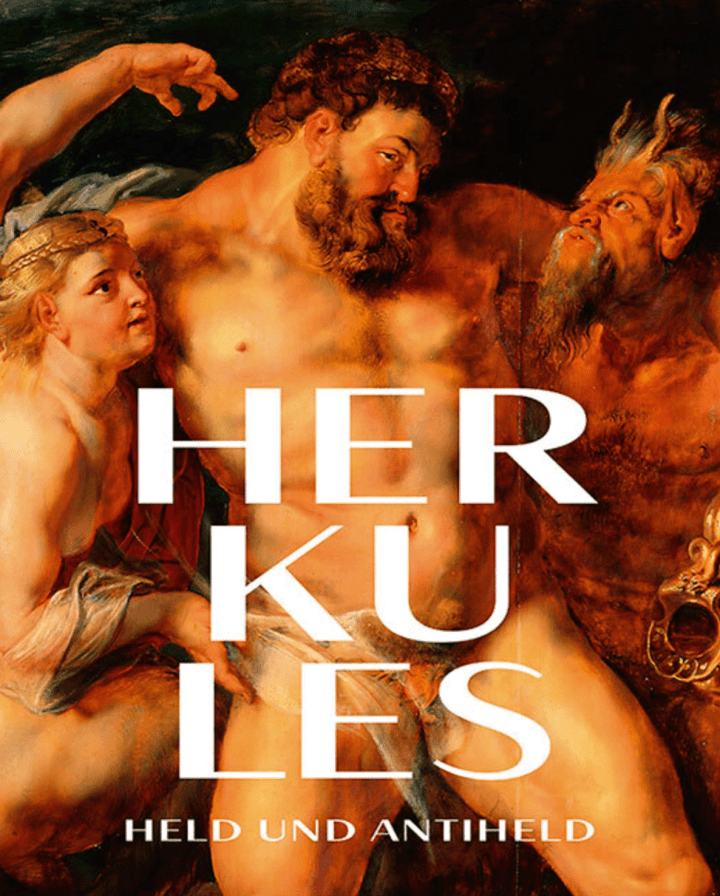 As the son of the supreme deity Zeus and the Theban queen Alcmene, Hercules was a demigod—with superhuman strength and human flaws. His popularity was revived during the Renaissance. In Rome, dozens of large-scale Hercules statues were already known in the sixteenth century, and these had a huge influence on early modern art. The exhibition showcases works of art from classical antiquity to the neoclassical period, with some glimpses into the present day. Alongside objects from the rich holdings of the Staatliche Kunstsammlungen Dresden, there are prestigious loans from such eminent institutions as the Vatican Museums in Rome, the Prado in Madrid, the Louvre in Paris, and the Ny Carlsberg Glyptotek in Copenhagen.
In a prologue and five chapters, the exhibition explores the famous ‘Labours of Hercules’, his relationships with women, his anti-heroic escapades, and his role as a model of virtue for rulers such as Alexander the Great and August the Strong. Balthasar Permoser’s colossal Saxon Hercules, created for the Rampart Pavilion of the Dresden Zwinger, bears witness to this.
Hercules was evidently not only strong and virtuous. In some situations, he behaved dishonourably, succumbed to vice, or committed cruel injustices, even against his own children. He often fought against evil for the good of humanity, but he was also a murderer, rapist, drunkard, and thief. Through significant works of art and an extensive accompanying programme, the exhibition encourages reflection on the role of heroism in history and its relevance in our society today. Particular attention is paid to the extraordinary narrative richness of the myth.
Videos telling eight of the stories about Hercules have been created specially for the exhibition. Dresden-born actor Martin Brambach—known for his role as Chief Inspector Peter Michael Schnabel in the television series Tatort—relates important and amusing episodes from the life of the hero and anti-hero. A multimedia guide is available free of charge.
Holger Jacob-Friesen, ed., Herkules: Held und Antiheld (Dresden: Sandstein Kultur, 2025), 200 pages, ISBN: 978-3954988945, €38.
Exhibition | French Enlightenment: From the Court of Versailles to Agen
Now on view at the Musée des Beaux Arts in Agen:
Lumières françaises, de la cour de Versailles à Agen
Église des Jacobins, Musée des Beaux Arts d’Agen, 5 December 2025 — 8 March 2026
Curated by Adrien Enfedaque
Six ans après l’exposition Goya, génie d’avant-garde. Le maître et son école, la Ville d’Agen s’engage dans une nouvelle exposition d’envergure, du 5 décembre 2025 au 8 mars 2026. L’église des Jacobins, espace du musée des Beaux-Arts, offrira le récit du bouillonnement qui accompagna la diffusion des idées des Lumières dans l’Agenais. Labellisée « Exposition d’intérêt national », cette nouvelle exposition est un atout pour l’attractivité et le rayonnement du territoire agenais. L’objectif de fréquentation est fixé à 30,000 visiteurs.
Le récit du siècle des Lumières en Agenais
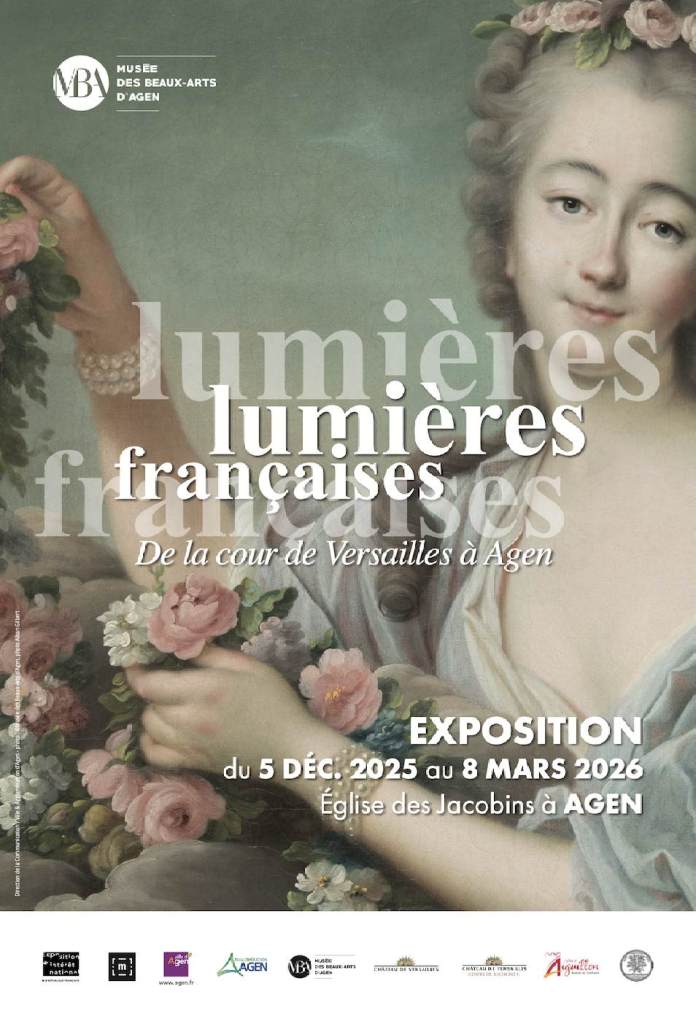 Agen et sa région connaissent au XVIIIe siècle une période de prospérité économique et culturelle. L’exil agenais du duc d’Aiguillon, ministre des Affaires étrangères du roi Louis XV et ami de Madame de Pompadour et de Madame Du Barry, joue un rôle prépondérant. L’exposition mettra tout particulièrement en valeur sa collection de peintures, conservée au musée, et notamment le Portrait de Madame Du Barry en Flore, peint par François Hubert Drouais en 1773–74, icône du portrait féminin du XVIIIe siècle publiée dans de nombreuses biographies consacrées à la favorite.
L’exposition abordera plusieurs grandes thématiques:
• Le pouvoir au XVIIIe siècle : politique, religieux et économique.
• L’art de vivre de la cour de Versailles à Aiguillon.
• Le mécénat artistique au XVIIIe siècle à travers les figures de Madame Du Barry et du duc d’Aiguillon.
• Les constructions du XVIIIe siècle et leur rôle dans l’identité du bâti de l’Agenais.
• Les idées des Lumières et l’influence des élites d’Agen, avec des coups de projecteur sur Montesquieu et la Société académique d’Agen, créée en 1776.
Des prêts prestigieux en provenance de grandes institutions telles que le château de Versailles, le musée du Louvre ou encore la Bibliothèque nationale de France viendront compléter le fonds du musée d’Agen et seront réunis dans l’écrin agenais que constitue l’église des Jacobins. Plus de 250 œuvres seront présentées au sein d’une scénographie immersive qui permettra de se plonger dans la vie à la cour et le siècle des Lumières. Ambitieuse et accessible, l’exposition déploiera un parcours adapté aux familles. Un riche programme d’animations sera également proposé.
The Louvre Opens Renovated Galleries of Italian and Spanish Paintings
From the press release, via Art Daily and the American Friends of the Louvre:
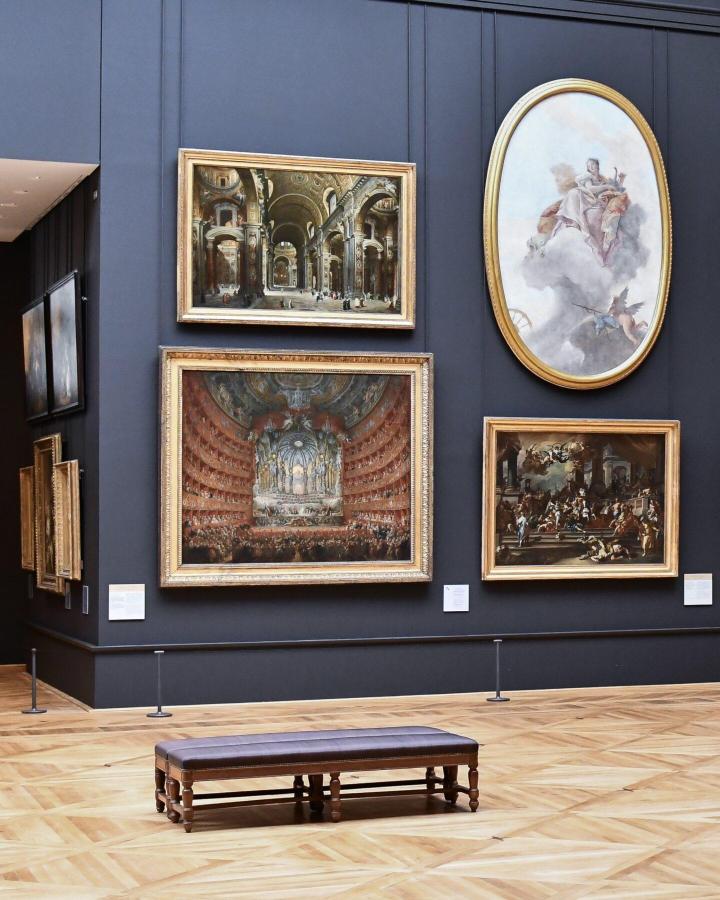 The Louvre has reopened its renovated galleries of Italian and Spanish painting from the 17th and 18th centuries, offering visitors a refreshed way to experience some of the museum’s most important works. After a year-long renovation, the galleries—located on the first floor of the Denon Wing—now feature a redesigned layout, updated lighting, newly painted walls, and improved interpretive materials that bring renewed clarity and depth to the collection.
The reopening marks more than a cosmetic update. It also reflects a major behind-the-scenes effort to reassess, conserve, and, in some cases, restore the paintings themselves. Many works had remained hung high on the walls since the galleries were first installed in 1999, limiting close inspection. During the renovation, each painting was examined, cleaned, and carefully evaluated for conservation needs. Several works benefited from substantial restoration campaigns, while frames and gilded surfaces were also treated by the Louvre’s specialist workshops. A new configuration of the Porte des Lions now provides faster access to these galleries, creating a more fluid connection between the Grande Galerie and the newly opened Gallery of the Five Continents on the ground floor.
Italian Painting: From Rome to Venice
In the Italian painting galleries, visitors can once again encounter works produced in Rome during the later 17th century, alongside paintings from Naples, Genoa, Florence, Milan, and Venice. Three canvases by Salvator Rosa introduce the Neapolitan school and lead into works by artists such as Luca Giordano, while the diversity of regional styles underscores the richness of Italian painting during this period.
The adjoining gallery dedicated to large-scale 18th-century works places Giambattista Piazzetta’s Assumption of the Virgin in dialogue with Giambattista Tiepolo’s Juno Amid the Clouds, acquired by the Louvre in 2020. Monumental canvases by Giovanni Paolo Panini complete the display, evoking the fascination that Rome exerted over artists and travelers across Europe.
Spanish Painting: From Devotion to Modernity
The first phase of the renovation of the Spanish painting galleries has also been completed, with a renewed focus on both conservation and interpretation. In the Murillo Gallery, restored monumental works from the 17th century return to view, including powerful scenes from the life of Saint Bonaventure by Francisco de Herrera the Elder and Francisco de Zurbarán. Their renewed color and scale reassert the dramatic impact these works once had in their original religious settings.
Beyond this space, the gallery devoted to Spanish painting from 1750 to 1850 highlights one of the Louvre’s greatest strengths: its collection of works by Francisco de Goya. Full-length portraits of Spanish aristocrats sit alongside more intimate images of figures close to the artist. The centerpiece remains Goya’s striking portrait of Ferdinand Guillemardet, painted in 1798 during the turbulent years of the French Republic. For the first time in this gallery, visitors can also encounter Goya’s engraved Disparates, whose unsettling imagery reveals a darker, more experimental side of the artist. These works offer a sharp contrast to his luminous portraits and expand the understanding of his technical and thematic range.
Looking Ahead
Not all works have yet returned to the walls. Murillo’s The Angels’ Kitchen, a monumental canvas currently undergoing major restoration, is expected to rejoin the galleries in autumn 2026. Further renovations are also planned: beginning in 2026, adjacent rooms will be refurbished to present Spanish and Portuguese paintings in smaller formats, spanning the 14th to the 19th centuries. With these renewed galleries, the Louvre offers visitors not only a refreshed visual experience, but also a deeper engagement with the history, materiality, and ongoing care of its collections—reminding audiences that museums are living institutions, constantly revisiting and rethinking the works they preserve.
The renovation was made possible through the generous support of the American Friends of the Louvre and the Sada Melo Family, in memory of Federico Sada González. Additional support was provided by Lionel and Ariane Sauvage and Naoma Tate.
Funding | Burlington Bursaries for Researching Drawings
From ArtHist.net:
The Burlington Magazine’s Travel Bursaries for Researching European Drawings
Applications due by 1 February 2026
We are delighted to announce a new initiative: The Burlington Magazine Travel Bursaries, generously funded by the Rick Mather David Scrase Foundation. These bursaries are designed to support emerging art historians undertaking research on old master drawings. The awards will fund travel to major collections worldwide to study works of Western art on paper from the Renaissance to 1900.
Typical awards will range from £2,000 to 2,500 for travel within Europe and £3,000–3,500 for intercontinental travel. Applications are welcomed from postgraduate and curatorial researchers worldwide. The deadline for applications is Sunday, 1 February 2026. Further details and application guidelines can be found at The Burlington website.
Call for Papers | Framing the Drawing / Drawing the Frame
From the Call for Papers as noted at ArtHist.net:
Framing the Drawing / Drawing the Frame
Bibliotheca Hertziana—Max Planck Institute for Art History, Rome, 13–15 May 2026
Organized by Tatjana Bartsch, Ariella Minden, and Johannes Röll
Proposals due by 16 January 2026
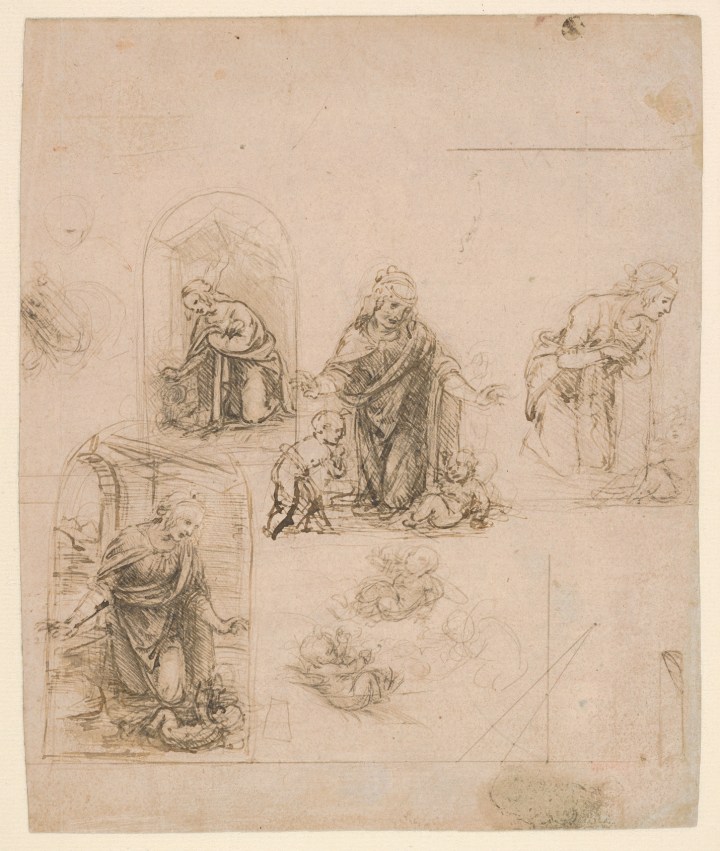
Leonardo da Vinci, Compositional Sketches for the Virgin Adoring the Christ Child, with and without the Infant St. John the Baptist, silverpoint, pen and brown ink, ca. 1480–85 (New York: The Metropolitan Museum of Art, 17.142.1). As Carmen Bambach notes in her entry for the drawing, “The geometric constructions at the lower right represent his attempts to work out the perspective within the composition, with respect to the spectator’s vantage point.”
The 2026 Gernsheim Study Days seek to explore the relationship between early modern drawings, frames, and framing.
In the early modern period, the frame as a physical object was something that could and, not infrequently, did cost more than the artwork it was framing. Together with the understanding of its economic value, the frame performed a monumentalizing role. The microarchitectural structure was used to signal the importance of an image through the imposition of new hierarchies of space. The symbolic dimension of the frame was both mobilized by artists as an integral part of compositional ensembles and retroactively applied to underscore the importance of certain images.
In the medium of drawing, with the physicality of the wrought object removed, the symbolic connotations associated with acts of framing came to be transposed to a two-dimensional plane, emphasizing the practice as a cultural technique. The form of elevation accomplished by the frame was transformed into a personal referencing system for the artist, part of a creative practice, where the addition of the drawn frame could transform a sheet of paper from an open field, a space for ideas to emerge, to a closed one, creating new hierarchies of space in the mise-en-page. Similarly, a drawn frame around a single motif on a sheet of paper with several motifs serves to illustrate the artist’s selection process and offers an opportunity for reflection on the connection between artist, viewer, and message to be conveyed. It is the goal of this conference to examine these semiotic potentials in and related to drawing in their multiplicity.
In addition to the generative role that forms of framing played in early modern drawings, we are interested in the framing of drawings themselves as it pertains to histories of collecting, reception, and museums. From Vasari’s Libro dei disegni to the modern passepartout, we seek to address how acts of framing shape or change our perception of drawings.
Finally, given the practical, economic, and symbolic significance of the frame, drawings for actual frames comprise an important line of inquiry in interrogating the relationship between drawing, frames, and framing. Alongside the use of the word cornice in Italian to refer to the frame in the early modern period, decorative surrounds were also identified in contemporary sources as ornamenti, a term that could refer both to the celebratory quality of frames as well as the nature of the frame as a liminal space or threshold where artists were able to reflect on the inventiveness of art making. In this context, papers might address the relationship between frame design and drawing and what impact—if any—the expanded drawing practices of the early modern period had on practices of framing.
We invite papers that treat frames and framing, broadly conceived, as they relate to drawing. Possible topics and questions that we hope to address include:
• Frame design and drawing for the decorative arts
• The role of frames and framing in the making or changing of meaning
• Inscriptions on drawings or, later, passepartouts, as a form of framing
• Marginalia as paratextual frames
• How the frame in drawing complicates our understanding of the frame
• The frame as mediator of drawings
• The frame as a metapictorial device
To submit a proposal, please upload a title, a 250-word abstract, and brief CV (no more than 2 pages) as a PDF document at https://recruitment.biblhertz.it/position/19759108 by 16 January 2026.
Conference languages are English, German, and Italian. The Bibliotheca Hertziana will organize and pay for accommodation and reimburse travel costs (economy class) in accordance with the provisions of the German Travel Expenses Act (Bundesreisekostengesetz).
Print Quarterly, December 2025
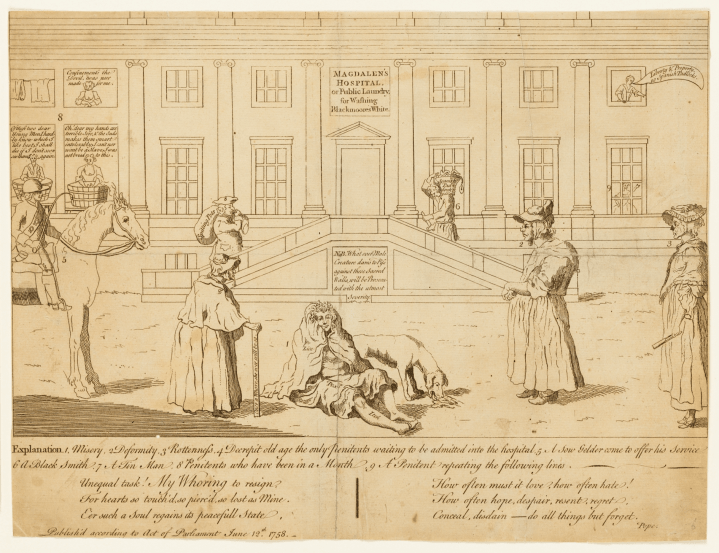
Anonymous artist, Magdalen’s Hospital, or Public Laundry for Washing Blackmoores White, 1758, etching, trimmed within the platemark, 232 × 307 mm (Oxford, Ashmolean Museum).
◊ ◊ ◊ ◊ ◊
The long eighteenth century in the latest issue of Print Quarterly:
Print Quarterly 42.4 (December 2025)
a r t i c l e s
• Xanthe Brooke, “Spaignolet’s Drawing Book: An Album with Ribera Prints at Knowsley Hall,” pp. 379–89. This article focuses on an unpublished album containing 28 prints mainly by or after Jusepe de Ribera (1591–1652). Brooke seeks to identify the sources and publishers of each impression, explores how the Earl of Derby used the album, and traces the growing taste for Ribera’s work among English collectors in the late seventeenth and the first decades of the eighteenth century.
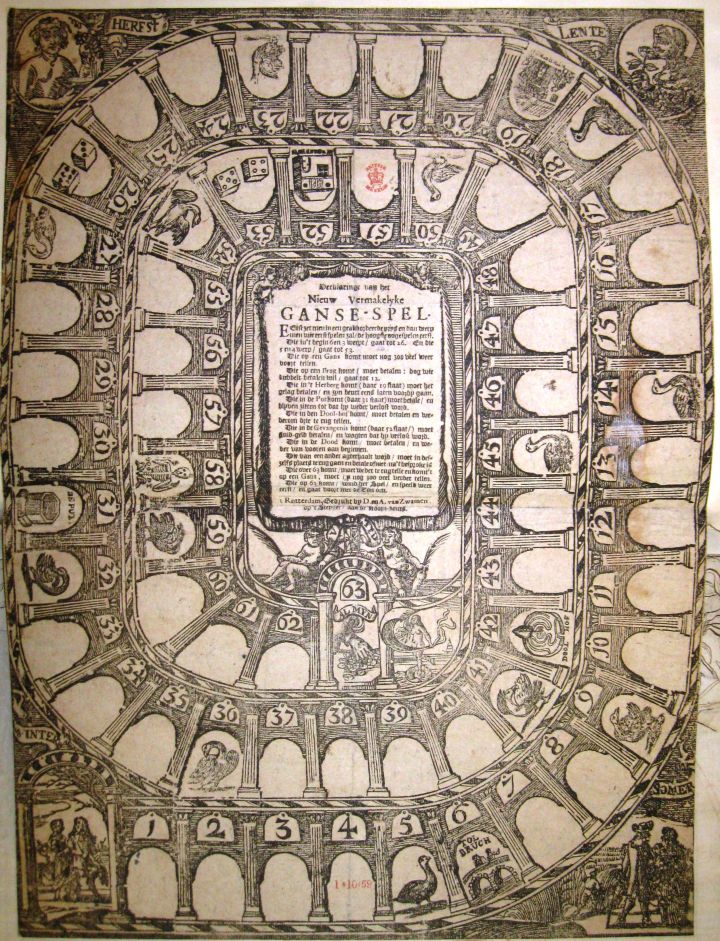
Anonymous artist, The New and Entertaining Game of the Goose, ca. 1759–87, woodcut, 470 × 360 mm (London: British Library, Creed Collection volume 8).
• Emma Boyd, “The Advent of the Magdalen Hospital: A Rare Satirical Print,” pp. 390–401. This article examines an anonymous etching in the Ashmolean Museum depicting the Magdalen Hospital, a charity for ‘penitent prostitutes’. The author discusses the print’s satirical commentary in relation to the charity’s controversial formation and the debates surrounding it. She also examines the print’s authorship within the context of other satirical prints and depictions of London street figures.
• Susan Sloman, “Gainsborough’s Cottage Belonging to Philip Thicknesse near Landguard Fort,” pp. 426–31. This short article contextualises an early etching by Thomas Gainsborough (1727–1788) from the 1750s, which the author proposes may have served as a subscription ticket for the engraving Landguard Fort, published in August 1754 by Thomas Major (1719–1799). The author also suggests that a painting by Gainsborough long assumed lost never existed.
• Felicity Myrone and Adrian Seville, “Two Unreported Games of the Goose in the Creed Collection in the British Library,” pp. 432–36. This short article describes two unknown examples of the Game of the Goose, one in printed form and the other in manuscript form. The provenance from the collection of London printseller Giles Creed (1798–1858), who specialized in ‘the history of ancient and modern inns, taverns, and coffee-houses’, is briefly traced.
n o t e s a n d r e v i e w s
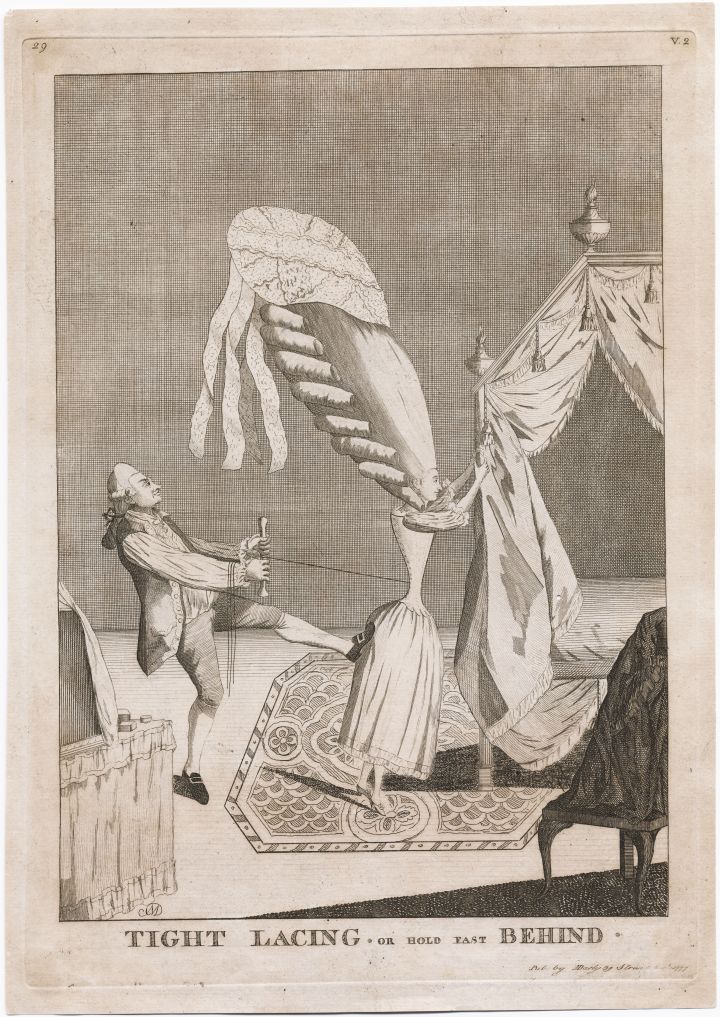
Anonymous artist, published by Matthew and Mary Darly, Tight Lacing, or, Hold Fast Behind, 1 March 1777, etching and engraving, 351 × 247 mm (Farmington, CT: Lewis Walpole Library, Yale University).
• Andaleeb Badiee Banta, Review of Cristina Martinez and Cynthia Roman, Female Printmakers, Printsellers, and Print Publishers in the Eighteenth Century: The Imprint of Women, c. 1700–1830 (Cambridge University Press, 2024), pp. 445–47.
• Jean Michel Massing, Review of Anna Lafont, L’art et la race: L’Africain (tout) contre l’œil des Lumières (Les presses du réel, 2019), pp. 447–48.
• Einav Rabinovitch-Fox, Review of Elizabeth Gernerd, The Modern Venus: Dress, Underwear, and Accessories in the Late 18th-Century Atlantic World (Bloomsbury Visual Arts, 2024), pp. 448–49.
• Mathilde Semal, Review of Rolf Reichardt, Éventails symboliques de la Révolution. Sources iconographiques et relations intermédiales (Presses universitaires de Rennes, 2024), pp. 450–52.
• Robert Felfe, Review of Matthew Zucker and Pia Östlund, Capturing Nature: 150 Years of Nature Printing (Princeton Architectural Press, 2022), pp. 452–54.
• Sarah Thompson, Review of Timothy Clark, ed., Late Hokusai: Society, Thought, Technique, Legacy (British Museum, 2023), pp. 479–83.
Fellowships | The Reception of Antique Works of Art and Architecture
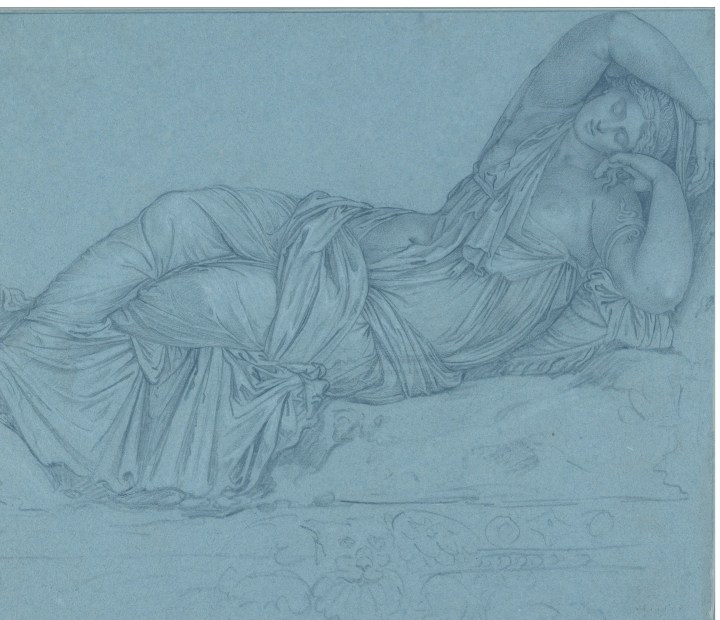
Hendrick Goltzius, Cleopatra/Ariadne, 1590–91, black and white chalk with pencil on blue paper, 25 × 30 cm
(Haarlem: Teylers Museum, purchased from the Odescalchi heirs in Rome, 1790, N061; CensusID 47461)
◊ ◊ ◊ ◊ ◊
From ArtHist.net:
Census Fellowship in the Reception of Antiquity, 1350–1900
Humboldt-Universität (Berlin), Bibliotheca Hertziana (Rome), Warburg Institute (London), March–December 2026
Applications due by 31 January 2026
The Institut für Kunst- und Bildgeschichte, Humboldt-Universität zu Berlin, the Bibliotheca Hertziana – Max Planck Institute for Art History, and the Warburg Institute, School of Advanced Study, University of London, are pleased to announce a fellowship in Berlin, Rome, and London, offered at either the predoctoral or postdoctoral level. These fellowships grow out of the longstanding collaboration between the Humboldt, the Hertziana, and the Warburg in the research project Census of Antique Works of Art and Architecture Known in the Renaissance.
The fellowships extend the traditional chronological boundaries of the Census and are dedicated to research and intellectual exchange on topics related to the reception of antiquity in the visual arts from approximately 1350 to 1900. In the context of the fellowships, the topic of the reception of antiquity is also broadly conceived without geographical restriction. Proposals can optionally include a digital humanities perspective, engage with the database of the Census, or make use of the research materials of the Census project available in Berlin, Rome, and London.
The Humboldt, the Hertziana, and the Warburg sponsor a research grant of 6 months for students enrolled in a PhD program (predocs), or 4 months for candidates already in possession of a PhD (early career postdocs). Fellows can set their own schedule and choose how to divide their time evenly between at least two institutes, of which one must be the Hertziana. The stipend will be set at about 1,500 EUR per month at the predoctoral level and about 2,500 EUR per month at the postdoctoral level, plus a travel stipend of 500 EUR. The fellowship does not provide housing.
The sponsoring institutes adhere to the principles of diversity, equity, and inclusion, and therefore encourage applications from underrepresented groups. Candidates can apply via the portal available on the Hertziana website. They should upload the requested PDF documents in English, German, or Italian by 31 January 2026, with details of their proposed dates for the fellowship during the year 2026 (starting earliest March, ending latest December 2026).










 Enfilade
leave a comment